 June 15, 2026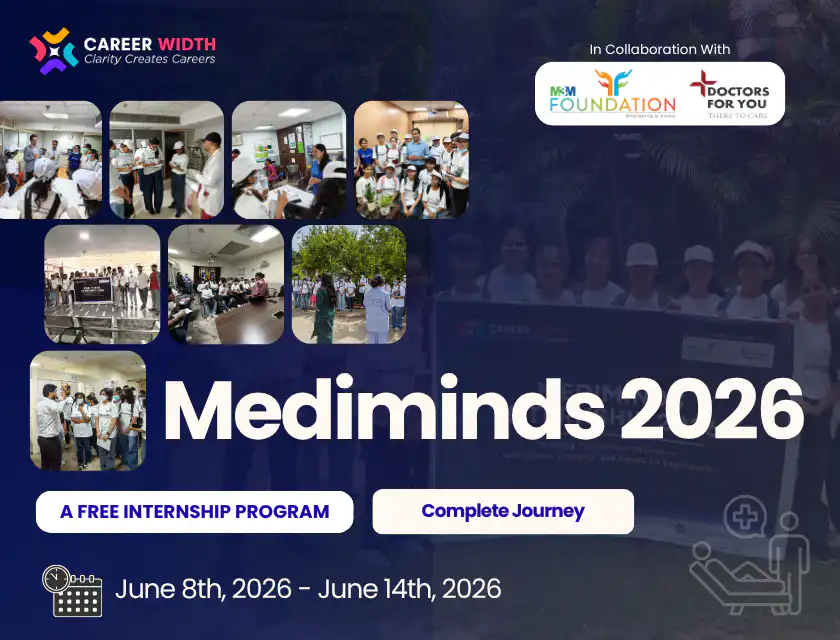
There are programs that look good on a resume. And then there are programs that change the way you think. MediMinds 2026 — Career Width’s flagship free healthcare internship, conducted in collaboration with M3M Foundation and Doctors For You (DFY) — was firmly the second kind.
Now in its fourth year since launching in 2023, MediMinds brought together 40 aspiring students for a structured seven-day journey into the heart of Indian healthcare. Six days of immersive field exposure, followed by a closing conference where students took the stage themselves. No fees, no barriers — just access to a world most students only read about in textbooks.
Table of Contents
ToggleDay 1 & 2: Two Worlds, One Spectrum
The program wasted no time easing anyone in gently. On the very first day, the cohort was split into two batches and sent in opposite directions.
Batch 1 reported to Meena Devi Jindal Hospital in Civil Lines, New Delhi, where a DFY representative opened the week not with a PowerPoint, but with a grounded conversation about what the days ahead would demand. Students toured the hospital department by department, watching how a functioning facility operates — and then rolled up their sleeves for a hands-on first aid training session conducted by the Medical Superintendent and nursing staff. Bandaging, basic life support, emergency response: the kind of learning that stays in your hands, not just your notes.
Batch 2 travelled out to the Government Institute of Medical Sciences in Greater Noida, where the focus was entirely different. Here, students engaged with Mobile Medical Units — vehicles that carry healthcare to communities that cannot easily reach it — and sat through a detailed session on Maternal and Child Health, learning the real numbers behind infant mortality, maternal nutrition, and vaccination coverage.
Day 2 was a deliberate mirror: the batches swapped locations. By the close of Tuesday, every student had experienced both ends of a crucial spectrum — the institutionalised hospital and the mobile, community-reaching model of care. That contrast was the point.
Day 3 & 4: Scale, Streets, and the Human Side of Medicine
The program stepped up significantly from Day 3 onward.
One batch was taken to Vardhman Mahavir Medical College and Safdarjung Hospital — one of the largest and busiest public hospitals in India. Students toured casualty wards, OPDs, diagnostics, and general wards, watching how thousands of patients are managed daily with limited resources and extraordinary skill. A ten-minute address from senior hospital leadership gave students a rare, candid view of what it takes to run a public health institution at scale. But the session most students would later describe as the week’s standout was a cancer awareness and education talk led by the Program Head — covering detection, prevention, myths, and the deeply human reality of oncological care. Students were also oriented to the hospital’s cancer helpdesk, learning how it functions and how they could contribute.
Meanwhile, the other batch went not to a hospital but to the community. At Wazirabad Signature Bridge, students helped mobilise patients for a health camp — walking into neighbourhoods, speaking with residents, encouraging people who were hesitant, pressed for time, or simply unaware of the services available to them. They learned something that no textbook covers well: how health messaging actually reaches people on the ground.
Day 4 took this further. One batch went deep into Mahipalpur Rangpuri Pahari, one of Delhi’s dense urban settlements, for another health camp — more crowded, more immediate, more human. The other batch got their turn at Safdarjung. By the end of Day 4, every student had stood inside a government teaching hospital and beside a roadside health camp. Both are India. Both are healthcare.
Day 5 & 6: Science, Careers, and Sixteen Years of Service
The program shifted base to Vasant Kunj for the final field days, and the tenor changed — more science, more reflection, more career.
One batch visited Primus Superspeciality Hospital in Chanakyapuri, a sharp contrast to the government hospitals earlier — sleek, specialist-focused, and private. Students toured departments with fresh perspective, then spent the afternoon with the Head of Pathology: microscopes, specimens, diagnostic workflows. Interactive sessions on Microbiology and Biotechnology followed, connecting lab science to the growing role of research in modern medicine.
The other batch spent the day at DFY’s head office, where they were given a deep-dive into Doctors For You’s sixteen-year journey — from disaster relief and pandemic response to everyday primary care in India’s most neglected corners. The Head of the Organisation addressed students directly, speaking about vision, values, and what it truly means to dedicate a career to service. Career talks followed: honest, unvarnished conversations about medicine, public health, NGO work, and healthcare management. The Q&A that closed the session was one of the most candid of the entire week.
Day 6 completed the swap. Every student had now experienced a private superspeciality hospital, a government teaching institution, a mobile medical unit, a community health camp, and the inner workings of one of India’s most respected healthcare NGOs. That is not a small thing.
Day 7: The Stage Belongs to the Students
The final day moved to the IIC Conference venue, and it belonged entirely to the cohort.
Students presented their learnings from the week — distilling hospitals, health camps, labs, and conversations into coherent, confident presentations before an audience of healthcare experts, parents, and educators. A keynote speaker placed their experiences within the larger story of healthcare in India.
The afternoon brought a distinguished panel discussion featuring Major General A.K. Singh (Retd.), a Military Medicine Veteran and Health Informatics Expert; Dr. Arshath Jyothi P.S., Assistant Professor at the All India Institute of Ayurveda; Dr. Nitin Gupta, Consultant Gastroenterologist; and Dr. Rajat Jain, President of Doctors For You. Their conversation covered healthcare innovation, public health, technology, and the real landscape of careers that awaited the students leaving the room.
Awards were distributed, recognising standout contributors across the cohort. Then, after a week of early mornings and full days, it was over.
What MediMinds 2026 Really Was
Career Width built MediMinds as a free internship — no fees, no barriers. M3M Foundation made the scale possible. And Doctors For You brought sixteen years of on-the-ground credibility to every hospital visit, every health camp, every honest career conversation.
As Manvee Bansal, Founder and CEO of Career Width, put it: “MediMinds was created to help students experience healthcare before choosing it as a career. Over the past four years, we have seen students become more informed, confident, and purposeful in their career decisions.”
Seven days. Six venues. Two health camps. Forty students. And a cohort that now sees the healthcare world a little differently — more honestly, more completely — than they did before.
An SEO Expert, Website Developer and Digital Marketer with 3+ years of experience – driving traffic, leads, growth, branding, and online success.