
 November 3, 2025
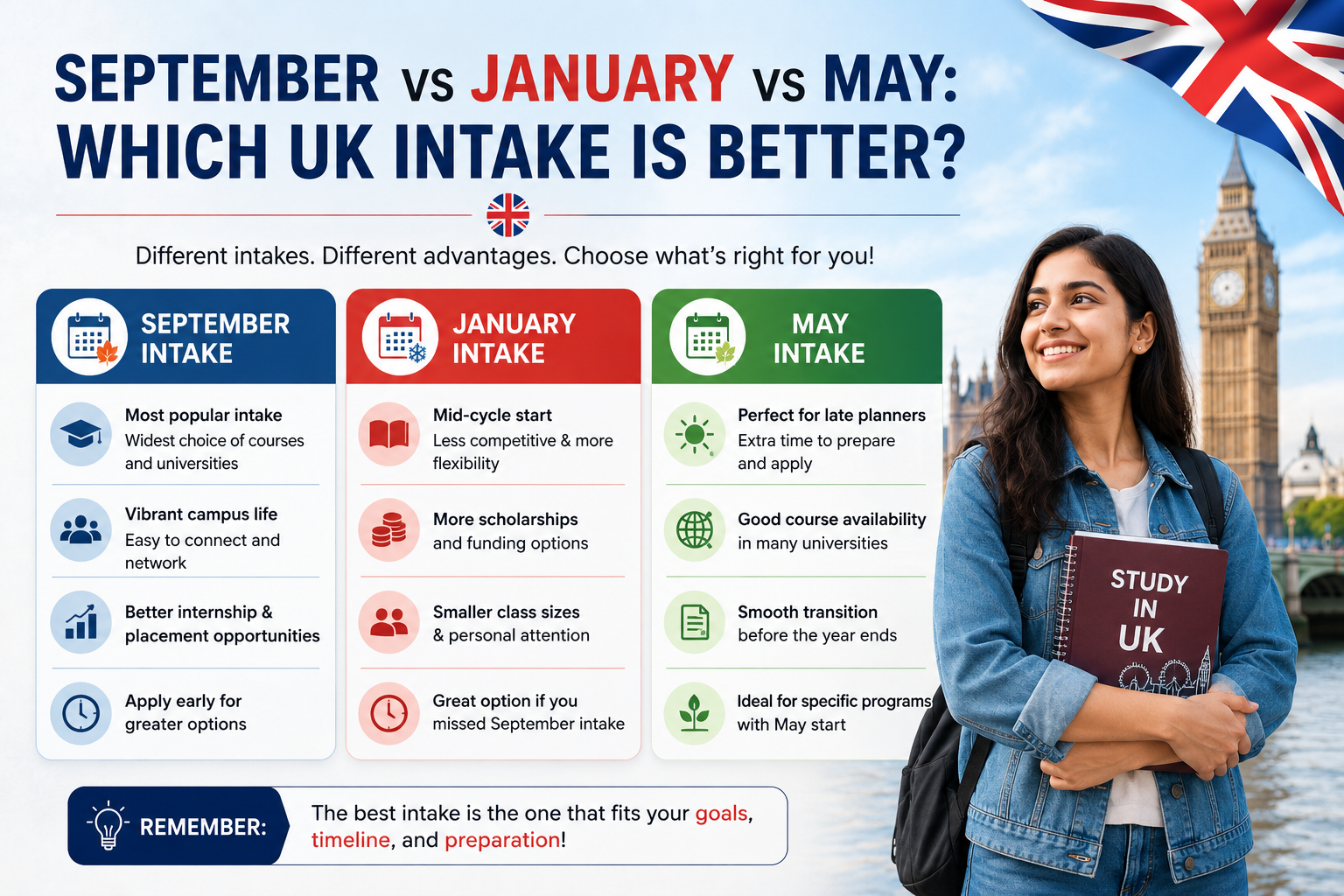
The main UK intakes for international students are September/October, January/February, and, for a limited number of courses, May/June. September is generally the largest intake and offers the widest choice of universities and programmes.
Thinking of studying in the UK in 2026? The UK intake that you choose will influence your entire experience as a study abroad student.
Finding a suitable university is just one step in this process. Before getting ready to write your Statement of Purpose, schedule an English language test, secure funding and apply for a Student visa, it’s important to consider one vital question:
“Which UK intake should I choose?”
UK is among the top countries where international students go to get a world-class education at prestigious universities, specialized courses and for many postgraduates, a one-year master’s degree program.
There is no universal application deadline for all universities and programs in the UK.
This guide explains the key UK intakes 2026, the deadlines to keep in mind, UK intakes for master’s degree, MBA intakes, visa preparation, scholarship opportunities and choosing the appropriate UK intake for your academic needs.
What Are UK Intakes?
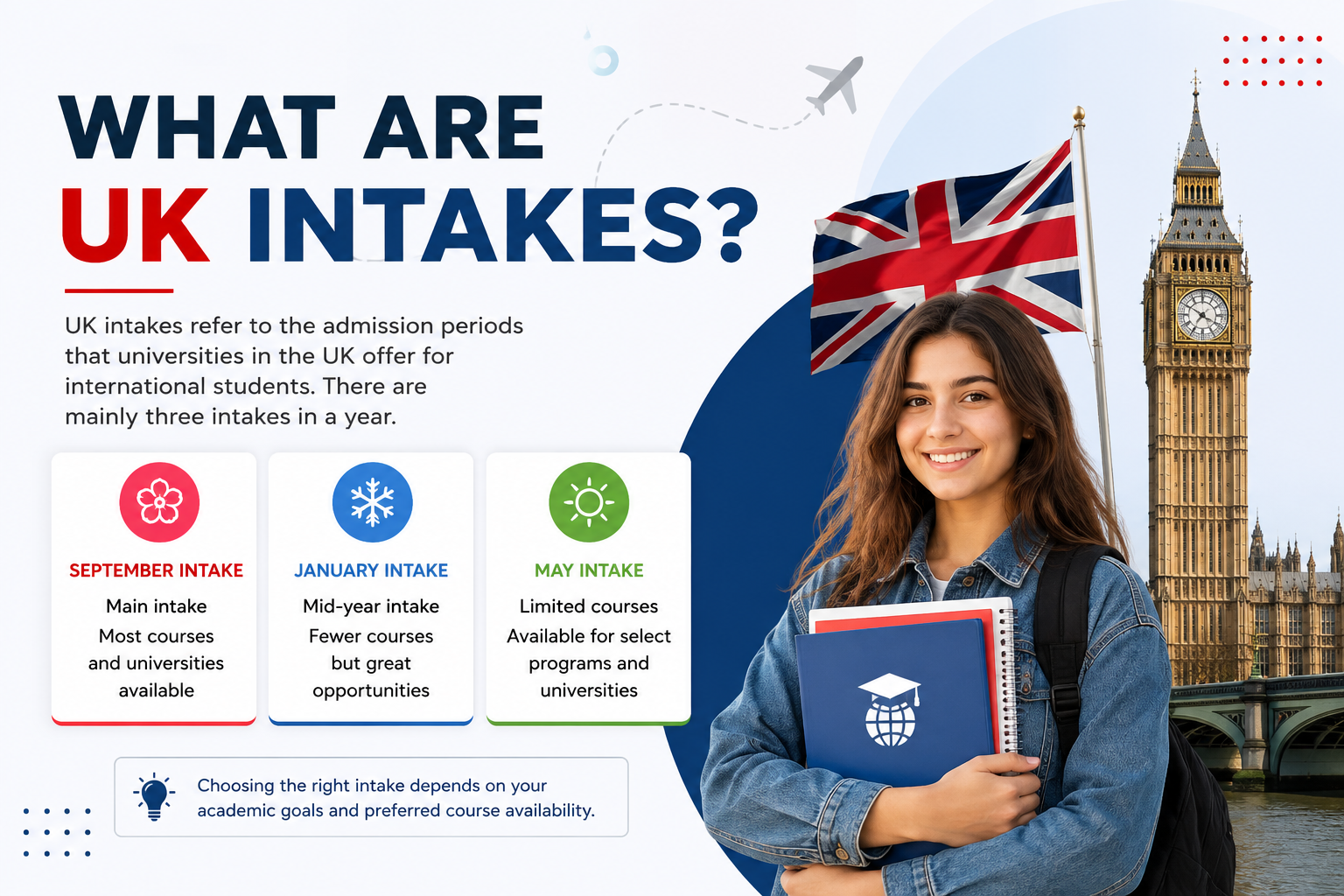
University intake is the time that a university starts accepting a fresh batch of students into a course.
Contrary to many countries where only one intake takes precedence in most courses, UK University Intakes 2026 may be different depending on the university, course, and study level.
Intake periods that you will come across include:
Intake | Typical course start | Availability | Best suited for |
September/October | September or October | Widest | Most undergraduate & postgraduate applicants |
January/February | January or February | Moderate | Students who miss September or need more preparation time |
May/June | May or June | Limited | Selected courses and universities |
In most cases, the September/October term continues to mark the traditional academic year commencement for the universities in UK, though there may be some flexibility for some programmes to have alternative start times.
Please note that January and May admission periods do not apply to all courses. There might be a course which starts from September but has no January intake or vice versa.
Thus, you should select your course and university first, and only then check out its admission period.
UK Intakes 2026 at a Glance
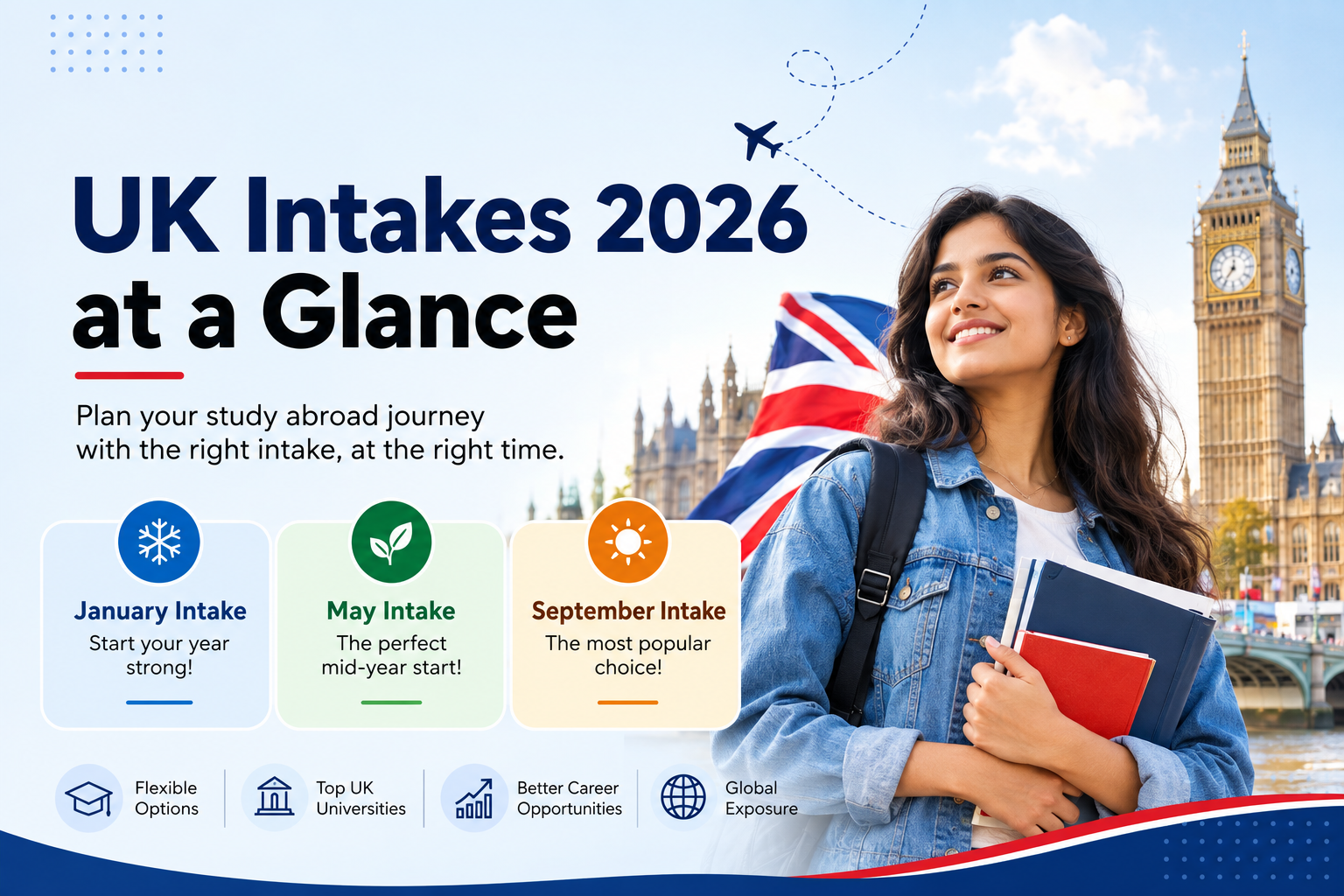
If you’re looking for a quick overview of UK intakes, here’s how the 2026 cycle generally works.
September/October 2026 Intake – The Main Intake
Consider September to be “the big launch” for the UK.
This will most likely be the time when you have access to most courses and universities.
It is highly recommended if you would like:
- The widest choice of universities
- Maximum course options
- More scholarship opportunities
- More time to prepare your application
- A traditional academic-year start
- More opportunities to connect with a large international student cohort
The UCAS application process applies to applicants of undergraduate courses. For applications in 2026, the deadline for equal consideration of most undergraduate courses is 14th January 2026 at 18:00 UK time. This does not mean that once the deadline expires, all universities will stop accepting applications; UCAS emphasizes that many universities will keep receiving international applications after this deadline depending on their space.
Postgraduate courses differ from undergraduate courses in application processes.
Most postgraduate programs in the UK do not have a single national application deadline but have a rolling deadline. The British Council advises students to apply early since many popular programs get full even before the beginning of the courses.
January/February 2026 Intake – The Second Chance Window
Missed September?
January can be your second opportunity.
The January/February intake is offered by a number of UK universities, particularly for selected master’s and professional programmes.
It can work well for students who:
- Need additional time to complete their bachelor’s degree
- Need more time to prepare for an English-language test
- Want additional time for financial planning
- Missed the September application cycle
- Need time to strengthen their application profile
However, the course selection is usually narrower than September.
The January intake should therefore be treated as an alternative intake- not a guaranteed second version of September.
May/June 2026 Intake – Smaller but Strategic
The May/June intake is much more limited.
Only selected universities and programmes may offer this start date, so students considering it need to research course availability carefully.
This intake may suit students who:
- Want to avoid waiting until September
- Have missed January
- Find a suitable programme with a May start
- Have already completed the academic and visa preparation process
The keyword here is “availability.”
Don’t select May simply because you want an earlier start. First confirm that your exact course, university and qualification are available for that intake.
UK Intakes for Masters: What Should You Know?

For international students, especially for Indian students, the UK remains one of the top destinations for master’s level studies.
The UK offers many advantages; one of them is the short time required to complete the programme, as there are many taught master’s degrees that can be completed in one year.
In your search for master’s intakes in the UK, you will normally find the following:
- September/October- This is usually the strongest option for master’s applicants because it offers the broadest selection of programmes.
- January/February- A number of universities offer January starts for selected master’s programmes.
- May/June- This is less common and highly programme-specific.
The important rule: Never assume that a university offering a master’s degree automatically offers that degree in every intake.
UK Intake Deadlines 2026: Is There One Fixed Deadline?
This is one of the biggest misconceptions among international students.
There is no single “UK Intake Deadline 2026” that applies to every university and course.
The deadline depends on:
- University
- Course
- Undergraduate or postgraduate level
- Intake
- Applicant’s nationality
- Scholarship
- Accommodation availability
- Visa/CAS requirements
- Remaining seats
For undergraduate applicants using UCAS, the 2026 cycle had specific published deadlines. For most undergraduate courses, the main equal-consideration deadline was 14 January 2026 at 18:00 UK time.
Postgraduate admissions are different. Many postgraduate courses have no fixed national deadline and may accept applications until places are filled.
So what is the safest strategy?
Do not plan for the last day; plan for the course you like.
Just because an institution states that it accepts applications till July, does not necessarily mean that July will be the best time for applying to it.
Competitions start much sooner for popular courses, scholarships and accommodation.
Early application means more choice.
UK Intakes for MBA: When Can You Start?

If you’re specifically researching UK intakes for MBA, the same principle applies: intake availability depends on the business school and programme.
MBA programmes may have:
- September/October starts
- January starts
- Occasionally other start dates for specific programmes
The MBA admission process can also be more involved than a standard master’s application.
Depending on the business school, applicants may need:
- Undergraduate degree
- Professional work experience
- GMAT/GRE or an approved alternative, where required
- English-language proficiency
- CV/resume
- Essays or Statement of Purpose
- Academic transcripts
- References
- Interviews
For MBA applicants, “Which intake?” should not be the first question.
A better sequence is:
Career goal → MBA type → Business school → Programme → Intake → Deadline
That approach can prevent a common mistake: choosing an intake and then discovering that your preferred MBA is not offered during that cycle.
Why Study in UK in 2026?
The question isn’t only about when you can start. It is also about why study in UK in the first place.
1. Globally recognised education – UK universities have a strong international reputation for teaching, research and academic quality. The British Council describes the UK as a global leader in research and academic excellence.
2. Shorter master’s programmes – Many UK master’s programmes can be completed in one year. This can reduce the time spent studying compared with longer postgraduate programmes in some other destinations.
3. Strong international exposure – UK universities attract students from across the world, creating multicultural classrooms and opportunities to develop international networks.
4. Wide range of specialised courses
Students can choose from traditional subjects as well as areas such as:
- Artificial Intelligence
- Data Science
- Business Analytics
- Finance
- International Business
- Cybersecurity
- Engineering
- Marketing
- Healthcare
- Law
- Design
- Sustainability
5. Post-study work opportunity
Under the existing conditions of the UK’s Graduate visa, graduates have access to staying in the UK for 2 years from the date of application till 31 December 2026. From 1 January 2027, this period will amount to 18 months. A PhD or any other doctoral-level graduate is granted 3 years.
Thus, the timing becomes especially important for future graduates who plan to build their career after graduating.
Important Note: The Graduate visa does not imply obtaining permanent residency status and having guaranteed employment.
UK Student Visa: What Happens After You Get Your Offer?
Getting an offer is exciting- but your journey isn’t over.
International students requiring a UK Student visa will have to undergo the immigration process once all university requirements are fulfilled and they obtain the necessary Confirmation of Acceptance for Studies (CAS).
According to the UK government:
- Students applying from outside the UK can apply for a Student visa up to 6 months before their course starts.
- A CAS is required for the Student visa application.
- The visa application must be made within the permitted timeframe after receiving the CAS.
This is why your intake timeline should look like a chain:
Course research → Application → Offer → Conditions → CAS → Visa → Accommodation → Travel → University
If one link is delayed, the entire chain can be affected.
Scholarships for UK Intakes 2026
Scholarships can make a significant difference to your overall study-abroad budget.
For the 2026-27 academic year, the British Council’s GREAT Scholarships programme offers £10,000 towards tuition fees for eligible one-year taught postgraduate courses at participating UK universities. The programme covers universities across England, Wales, Scotland and Northern Ireland, with eligibility depending on nationality and participating institutions.
However, scholarship deadlines are often different from university application deadlines.
Never wait for the university deadline to check scholarships.
A smart applicant researches:
- University scholarships
- Government scholarships
- External scholarships
- Country-specific funding
- Course-specific awards
The 2026 UK Intake Timeline You Can Actually Follow
Instead of memorising dozens of deadlines, use this simple framework.
9-12 Months Before Your Intake
- Identify your career goal
- Choose potential courses
- Shortlist universities
- Check eligibility
- Estimate tuition and living costs
- Research scholarships
6-9 Months Before
- Prepare your CV
- Arrange academic documents
- Take IELTS/PTE/other accepted English test if required
- Prepare your SOP/personal statement
- Arrange references
- Start applications
3-6 Months Before
- Track offers
- Meet conditional requirements
- Confirm your university
- Plan finances
- Apply for scholarships where available
- Prepare for the CAS process
After CAS
- Check your Student visa requirements
- Submit your visa application within the permitted window
- Arrange accommodation
- Plan travel
- Prepare for arrival
The British Council’s recommended application journey similarly moves from choosing a course and applying through accepting an offer, arranging funding, applying for a visa and preparing for the move.
There is no universal winner.
The best intake is the one that matches your course, profile and timeline.
Factor | September/October | January/February | May/June |
Course availability | ⭐⭐⭐⭐⭐ | ⭐⭐⭐ | ⭐ |
University choice | ⭐⭐⭐⭐⭐ | ⭐⭐⭐ | ⭐⭐ |
Scholarship opportunities | Usually strongest | Moderate | Limited/varies |
Application flexibility | Moderate | Good for late planners | Limited |
Suitable for master’s | Yes | Yes, selected courses | Selected courses |
Suitable for MBA | Yes | Yes, depending on school | Less common |
Overall popularity | Highest | High | Lower |
Our recommendation: If your chosen university and course are open in September and you are prepared academically and financially, then September is the more flexible choice for you.
However, if your chosen programme is offered in January, or you need more time to get yourself ready, then January may suit you very well.
Common Mistakes Students Make With UK Intakes
- Mistake 1: Assuming every university has three intakes
Not true. Intake availability varies by course and institution.
- Mistake 2: Applying only when the deadline is near
A deadline is not necessarily the best time to apply.
- Mistake 3: Confusing UCAS deadlines with master’s deadlines
Most undergraduate applications use UCAS, while postgraduate applications commonly follow university-specific processes and deadlines.
- Mistake 4: Ignoring scholarship deadlines
A university application deadline and scholarship deadline can be completely different.
Mistake 5: Starting visa planning too late
A university offer is not the same thing as being ready to travel.
Mistake 6: Choosing a university only because of its ranking
Ranking matters- but so do course content, location, fees, employability, industry connections, entry requirements and your long-term career plans.
Your Intake Should Follow Your Career- Not the Other Way Around
Here’s a simple way to think about it:
Don’t ask: “Which intake is available?”
Ask: “Which course, university and intake give me the strongest path toward my career goal?”
For example, if your goal is to build a career in finance, choosing a university simply because it has a January intake may not be the smartest decision if your preferred finance programme is available only in September.
This is where Career Width can make the process more strategic.
How We Can Help You With Your UK Study Journey
Picking a UK intake can seem straightforward from a calendar’s perspective, but in reality, it’s comprised of many interrelated decisions.
Course → University → Intake → Application → Scholarship → Offer → CAS → Visa → Accommodation → Career
Career Width provides end-to-end study-abroad guidance, including career counselling, profile evaluation, university and course shortlisting, application support, visa assistance and pre-departure/accommodation support.
- Personalised Career Counselling
- Profile Evaluation
- University & Course Shortlisting
- Application & Documentation Support
- Visa Guidance
- Pre-Departure & Accommodation Support
- A Career-First Approach
Ultimately, the goal isn’t simply: “Get admission to a UK university.”
The bigger goal is: “Choose an education pathway that supports the career you want to build.”
And that’s where the width in Career Width matters.